
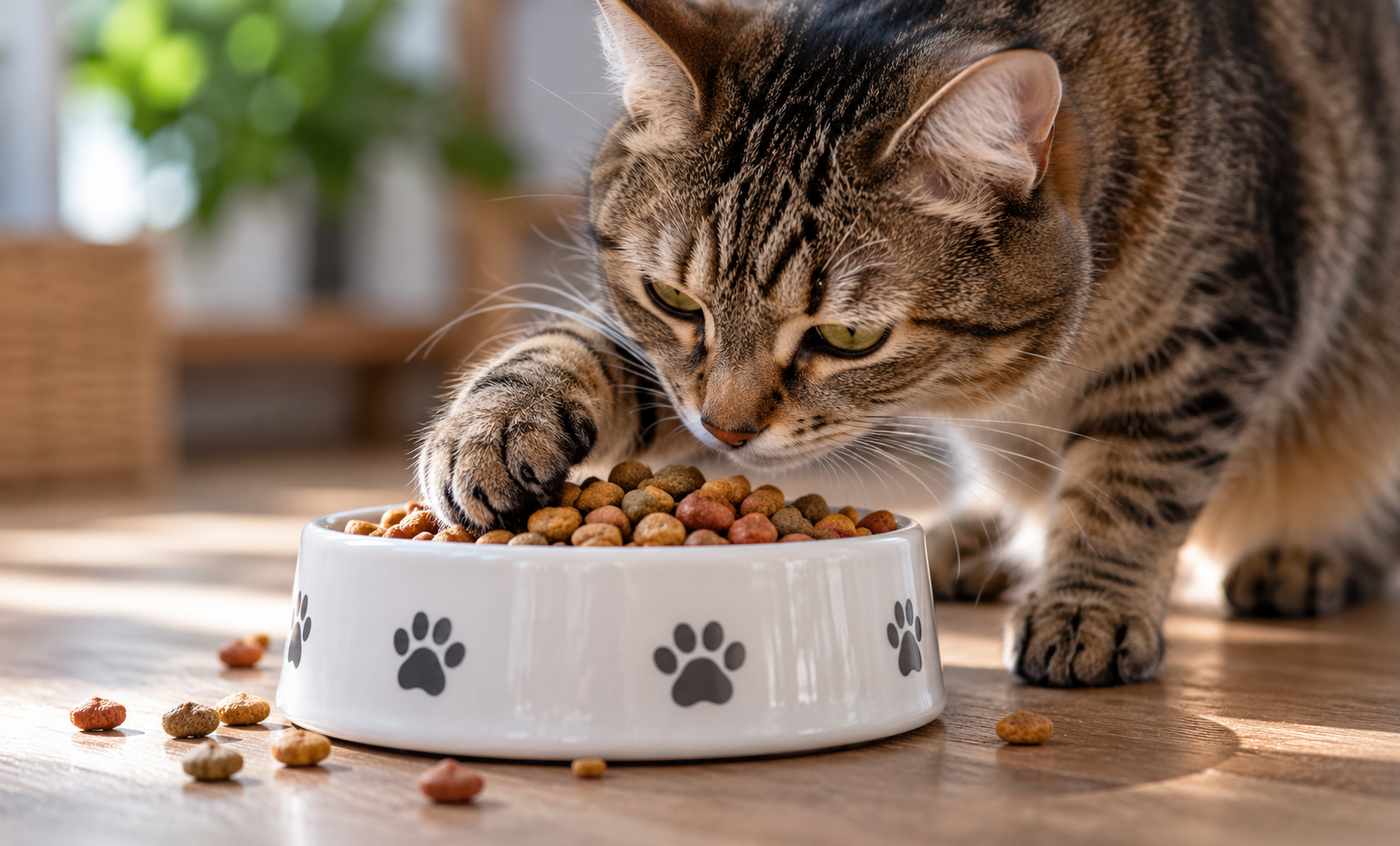
Nationwide – A new laboratory investigation into cat food sold in the United States has found detectable levels of lead, arsenic, cadmium, mercury, glyphosate and plastic-related chemicals across a wide range of products.
The 2026 Cat Food Category Report, released by the nonprofit Clean Label Project, examined 100 cat food products from 62 brands and tested them for more than 122 industrial and environmental contaminants. Testing was conducted by an independent laboratory accredited to ISO 17025 standards.
The findings raise questions about the contaminants cats may be exposed to through foods they consume every day, particularly because many cats eat the same food repeatedly for years.
Heavy metals were widespread
Lead was detected in 99 percent of the products tested.
Cadmium was detected in 96 percent, while arsenic was detected in 94 percent. Clean Label Project stresses that detecting a contaminant does not automatically mean a product is dangerous; the amount and duration of exposure are important when evaluating risk.
The investigation also found meaningful differences depending on the type of food and protein used.
Dry food had more lead
Dry cat food contained approximately three times as much lead as wet or air-dried food, when results were compared on a per-calorie basis.
Fish-based foods stood out for mercury
Fish and seafood formulas contained approximately 18 times more mercury than foods based on other proteins.
Among wet foods alone, fish and seafood formulas contained nearly 28 times as much mercury as wet foods made with other proteins.
Nearly half—48.6 percent—of fish and seafood products ranked in the highest mercury group. No poultry-based product did.
Fish and seafood products also contained approximately 2.5 times more cadmium than other protein-based foods.
That doesn’t mean every fish-based food was high in mercury. Clean Label Project says some fish-based products performed well in its testing. The findings instead suggest that protein source can make a substantial difference in contaminant levels.
Glyphosate was found in more than one-third of products
The herbicide glyphosate was detected in 37% of the cat foods tested.
The report found that foods containing more plant ingredients tended to have higher glyphosate levels. Each additional plant ingredient among the first 10 ingredients was associated with approximately a 40% increase in glyphosate levels.
The report also detected AMPA, a breakdown product of glyphosate, in 12% of the products.
Glyphosate’s health significance remains controversial. The International Agency for Research on Cancer classified glyphosate as “probably carcinogenic to humans” in 2015, while the U.S. Environmental Protection Agency has disagreed with that classification. Those assessments concern human health, and they do not establish that the levels detected in cat food cause disease in cats.
A plastic chemical was found in nearly half the foods
Another finding involved DEHP, or di(2-ethylhexyl) phthalate, a plasticizer used in plastics and some food-contact materials.
DEHP was detected in 48 of the 100 products.
Among products in which DEHP was detected, canned and pouched foods contained approximately five times more than bagged products.
Other chemicals were detected as well. Dibutyl phthalate was found in 26 products, although none reached a quantifiable level. Acrylamide was measurable in four products and present at very low levels in another 24. BPA was detected in two products and BPS in one.
The first ingredient doesn’t tell the whole story
One of the report’s more interesting findings involved ingredient lists.
In 35 of the 100 products, the ingredient listed first was outnumbered by ingredients from another category among the first 10 ingredients. In many cases, plant ingredients made up most of those top ten ingredients.
Clean Label Project says this matters because simply seeing a meat or fish ingredient listed first doesn’t necessarily tell consumers what contaminants may be present in the finished food.
What does this mean for cats?
This is where some caution is important.
The Clean Label Project study does not establish that the tested foods are unsafe, nor does it show that cats eating them have developed illnesses.
Each product came from a single batch, meaning the testing cannot tell us how consistent contaminant levels are from one batch to another. And the study compared contaminant levels among products rather than determining whether individual products cause disease.
The Pet Food Institute, which represents pet-food manufacturers, criticized the study’s interpretation, saying that the results were compared with Clean Label Project’s proprietary “purity standard” rather than regulatory safety limits or science-based risk assessments. The organization also emphasized that detectable amounts of some metals can occur naturally in soil, water and other environmental sources.
At the same time, the 2026 investigation is not the only recent research finding heavy metals in commercial cat food.
A peer-reviewed study published in Scientific Reports in 2025 analyzed 45 cat foods and 48 dog foods sold in China and found widespread contamination with several toxic metals, including arsenic, mercury, cadmium and lead. The researchers found that all 45 cat-food samples contained arsenic and chromium, while mercury was detected in 43 of the 45 cat foods. Some samples exceeded Chinese limits for lead or chromium.
Another 2025 study in the Journal of Food Composition and Analysis examined 101 commercial dry cat foods in Europe and found that fish-based formulations had the highest concentrations of several toxic elements. The researchers specifically identified fish by-products as important contributors to toxic-element accumulation.
And a 2026 peer-reviewed study examining 300 commercial dry cat foods and dietary exposure in cats found significantly higher cadmium concentrations in fish- and red-meat-based diets than poultry-based diets. Importantly, the researchers reported that the measured concentrations were generally within suggested guidelines and found no consistent accumulation in the cats’ biological samples according to protein source or feeding duration.
That makes the new Clean Label Project findings worth paying attention to—but also illustrates why “detected” should not automatically be translated into “dangerous.”
What could these contaminants do to cats?
Repeated exposure to heavy metals such as lead, arsenic, cadmium and mercury can potentially affect the nervous system, digestive system, liver and kidneys. The kidneys are particularly important because they filter many substances from the blood, and some metals can accumulate in kidney tissue and cause cellular damage or oxidative stress. Vca
For cats, this is especially worth watching because chronic kidney disease is common in older cats, and research has found that cats can accumulate certain metals in their kidneys. However, research has not established that the levels detected in commercial cat food in this new investigation cause kidney disease.
Plastic chemicals and pesticides such as DEHP and glyphosate raise a different concern: long-term, repeated exposure may add to a cat’s overall chemical burden, although the health effects of the specific levels found in this investigation are not yet known.
The key point is: “detected” does not automatically mean “toxic.” Even Clean Label Project cautions that its findings are not a safety determination for any individual product.
What can cat owners do?
Clean Label Project’s report suggests that owners consider varying protein sources, particularly if a cat eats fish-based food exclusively.
The organization also recommends looking beyond the first ingredient on the label and considering the overall ingredient list.
For owners concerned about contaminants, one practical question to ask a pet-food manufacturer is:
Does the company routinely test finished products for heavy metals, pesticides and other environmental contaminants—and can it provide information about those tests?
Brands included in the investigation
The 62 brands/products tested included foods from Purina, Acana, American Journey, Applaws, BIXBI, Blue Buffalo, Boss Cat, Carna4, Chicken Soup for the Soul, Diamond Naturals, Dr. Marty’s, Fresh Is Best, Freshpet, Fromm, Fussie Cat, Go! Solutions, Grandma Lucy’s, Green Juju, Hill’s Science Diet, The Honest Kitchen, I and Love and You, Iams, Instinct, Kirkland Signature, Merrick, Meow Mix, Nulo, Nutrish, Open Farm, Orijen, PawTree, Primal, Redbarn, Reveal, Royal Canin, Sheba, Smallbatch, Smalls, Solid Gold, Special Kitty, Stella & Chewy’s, Tiki Cat, Vital Essentials, Wellness, Weruva, Whole Hearted, Whole Life and Ziwi Peak, among others. The complete tested-product list is available from Clean Label Project.
Sources & latest studies
- Clean Label Project — 2026 Cat Food Study and full report — primary source for the 100-product investigation.
- Clean Label Project — Complete tested-product list — individual products and brands tested.
- Scientific Reports — 2025 study of toxic metals in commercial cat and dog food — peer-reviewed research.
- Journal of Food Composition and Analysis — 2025 study of 101 commercial dry cat foods — peer-reviewed research on toxic elements and protein sources.
- Veterinary Research Communications — 2026 study of 300 dry cat foods and cats consuming different protein sources — particularly useful because it included both food testing and cats.
- Petfood Industry — industry response to the Clean Label Project findings — includes the Pet Food Institute’s response and additional methodology details.
Support National Animal News — shop official merchandise to help fund
independent investigations and reporting.
9 Comments
NOW THERE’S GOOD WET FOOD FOR CATS AND BAD WET FOOD…??????
WHY IS THIS HAPPENING TO START WITH?????
THIS SHOULDN’T BE THE CASE!
NOW ONE HAS TO WATCH WHAT ONE BUYS FOR THEIR BELOVED PET????
Nothing new here! Always has been this way!
Which wet and dry foods are SAFEST please?
Never mind…I clicked on Clean Label Study underlined in the article and got lists of best wet and dry cat foods. Wonderful!
Is there any good cat food? Wish they said which to avoid and which to eat.
Click on Clean Label Study underlined in article and both the full study comes up in a PDF you can download and there are 2 graphics showing best wet and dry foods!
Is there any good cat food? Wish they said which to avoid and which to eat.
Is there any good cat food? Wish they said which to avoid and which to eat.
Is there any good cat food? Wish they said which to avoid and which to eat.